Hybrid Ecommerce POS Integration Architecture
About This Architecture
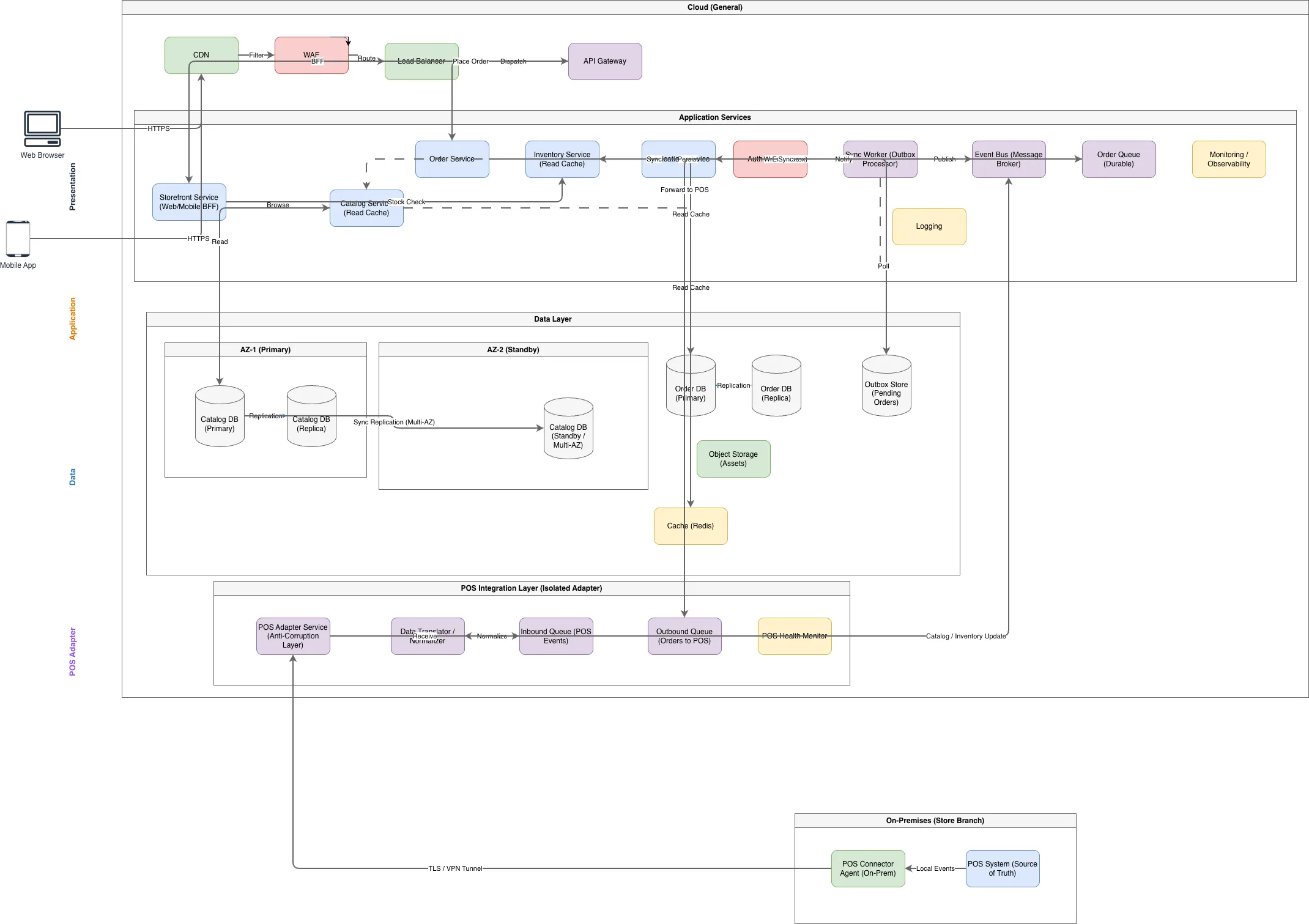
Hybrid ecommerce POS integration architecture connecting cloud-based storefront services with on-premises point-of-sale systems through an isolated adapter layer. Web and mobile clients route through CDN, WAF, and load balancer to an API Gateway, which orchestrates Storefront, Catalog, Order, Inventory, and Notification Services backed by replicated databases and Redis cache. A Sync Worker processes an Outbox Store via an Event Bus, while a dedicated POS Integration Layer with anti-corruption pattern translates between cloud Order Service and on-premises POS Connector Agent using inbound and outbound queues. This architecture isolates POS coupling, ensures eventual consistency across hybrid boundaries, and provides monitoring and health checks for both cloud and store-branch systems. Fork and customize this diagram on Diagrams.so to adapt the adapter pattern, queue topology, or database replication strategy for your retail environment.
People also ask
How do you integrate a cloud ecommerce platform with on-premises POS systems while maintaining loose coupling and eventual consistency?
Use an isolated POS Integration Layer with an anti-corruption adapter that translates between cloud Order Service and on-premises POS Connector Agent via inbound and outbound queues. A Sync Worker processes an Outbox Store through an Event Bus, ensuring orders sync reliably without tight coupling. This pattern isolates POS complexity and allows independent scaling of cloud and store-branch systems
- Domain:
- Cloud Multi
- Audience:
- Solutions architects designing hybrid ecommerce platforms with POS integration
Generated by Diagrams.so — AI architecture diagram generator with native Draw.io output. Fork this diagram, remix it, or download as .drawio, PNG, or SVG.
