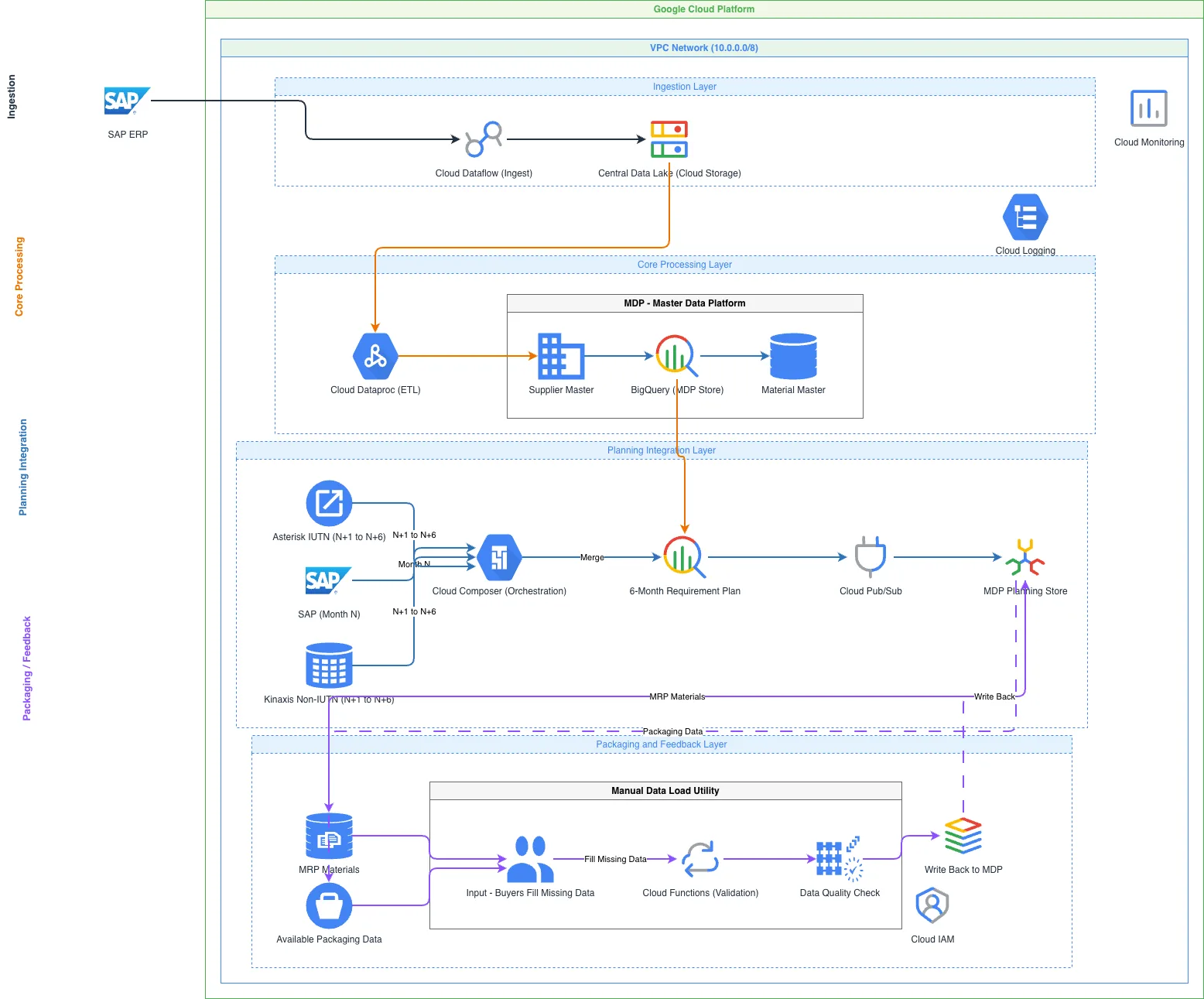
GCP Supply Chain Data Architecture Pipeline

GENERALArchitectureadvanced
GCP Supply Chain Data Architecture Pipeline — GENERAL architecture diagram

About This Architecture

End-to-end supply chain data architecture integrating SAP ERP, demand planning systems (Kinaxis, Asterisk), and master data through Google Cloud Platform services. Data flows from SAP via Cloud Dataflow into Cloud Storage, then through Cloud Dataproc ETL to populate BigQuery master data stores (Supplier Master, Material Master). Planning integration orchestrated by Cloud Composer combines SAP Month N forecasts with N+1 to N+6 demand signals via Cloud Pub/Sub into a 6-Month Requirement Plan, feeding downstream MRP and packaging workflows. Manual buyer inputs validated through Cloud Functions ensure data quality before write-back to the MDP Planning Store. This architecture demonstrates best practices for multi-source supply chain consolidation, automated validation, and real-time orchestration at scale. Fork and customize this diagram on Diagrams.so to adapt the pipeline for your supply chain topology, data sources, or planning horizons.

People also ask

How do you build a scalable supply chain data pipeline on Google Cloud that integrates SAP ERP with demand planning systems and enforces data quality?

This diagram shows a complete GCP supply chain architecture: SAP ERP feeds Cloud Dataflow for ingestion into Cloud Storage, Cloud Dataproc transforms data into BigQuery master stores (Supplier, Material), while Cloud Composer orchestrates demand planning from Kinaxis and Asterisk into a 6-Month Requirement Plan via Cloud Pub/Sub. Manual inputs are validated through Cloud Functions before write-bac

GCPdata-engineeringETLsupply-chainBigQueryCloud-Dataflow
Domain:
Data Engineering
Audience:
Data engineers designing supply chain ETL pipelines on Google Cloud Platform

Generated by Diagrams.so — AI architecture diagram generator with native Draw.io output. Fork this diagram, remix it, or download as .drawio, PNG, or SVG.

Generate your own architecture diagram →

About This Architecture

End-to-end supply chain data architecture integrating SAP ERP, demand planning systems (Kinaxis, Asterisk), and master data through Google Cloud Platform services. Data flows from SAP via Cloud Dataflow into Cloud Storage, then through Cloud Dataproc ETL to populate BigQuery master data stores (Supplier Master, Material Master). Planning integration orchestrated by Cloud Composer combines SAP Month N forecasts with N+1 to N+6 demand signals via Cloud Pub/Sub into a 6-Month Requirement Plan, feeding downstream MRP and packaging workflows. Manual buyer inputs validated through Cloud Functions ensure data quality before write-back to the MDP Planning Store. This architecture demonstrates best practices for multi-source supply chain consolidation, automated validation, and real-time orchestration at scale. Fork and customize this diagram on Diagrams.so to adapt the pipeline for your supply chain topology, data sources, or planning horizons.

People also ask

How do you build a scalable supply chain data pipeline on Google Cloud that integrates SAP ERP with demand planning systems and enforces data quality?

This diagram shows a complete GCP supply chain architecture: SAP ERP feeds Cloud Dataflow for ingestion into Cloud Storage, Cloud Dataproc transforms data into BigQuery master stores (Supplier, Material), while Cloud Composer orchestrates demand planning from Kinaxis and Asterisk into a 6-Month Requirement Plan via Cloud Pub/Sub. Manual inputs are validated through Cloud Functions before write-bac

GCP Supply Chain Data Architecture Pipeline

AutoadvancedGCPdata-engineeringETLsupply-chainBigQueryCloud-Dataflow
Domain: Data EngineeringAudience: Data engineers designing supply chain ETL pipelines on Google Cloud Platform
0 views0 favoritesPublic

Created by

May 4, 2026

Updated

May 4, 2026 at 6:56 AM

Type

architecture

Need a custom architecture diagram?

Describe your architecture in plain English and get a production-ready Draw.io diagram in seconds. Works for AWS, Azure, GCP, Kubernetes, and more.

Generate with AI