First Citizens Bank - Lead and Referral Hub Data
GENERALData Pipelineadvanced
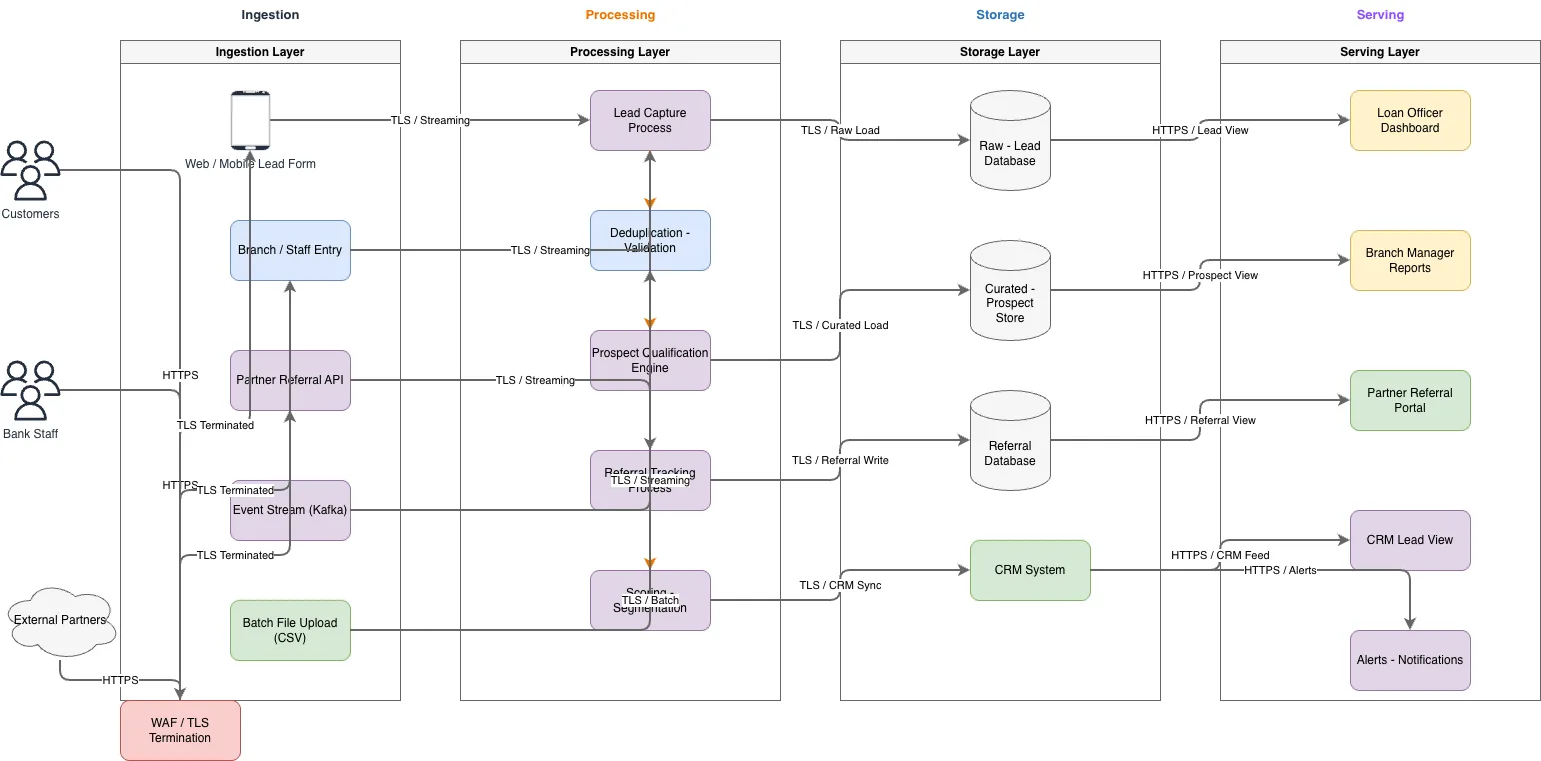
First Citizens Bank - Lead and Referral Hub Data — GENERAL data pipeline diagram

About This Architecture

First Citizens Bank's Lead and Referral Hub ingests customer leads from web forms, branch staff, and partner APIs into a unified data pipeline powered by Kafka event streams and batch CSV uploads. The Processing Layer applies lead capture, deduplication, validation, prospect qualification, referral tracking, and scoring-segmentation to cleanse and enrich raw lead data. Processed prospects flow into specialized storage—Raw Lead Database, Curated Prospect Store, Referral Database, and CRM System—enabling loan officers, branch managers, and partners to access actionable insights via dashboards, reports, and portals. This architecture demonstrates best practices for multi-source lead aggregation, real-time and batch processing, and role-based data serving in retail banking. Fork and customize this diagram on Diagrams.so to adapt the pipeline for your institution's lead sources, qualification rules, and downstream systems.

People also ask

How do banks build unified lead management systems that ingest from multiple sources and serve insights to loan officers and branch managers?

This diagram shows a four-layer architecture: Ingestion (web forms, branch entry, partner APIs, Kafka streams, batch uploads) → Processing (lead capture, deduplication, validation, qualification, scoring) → Storage (raw, curated, referral, CRM databases) → Serving (dashboards, reports, portals, alerts). This pattern ensures data quality, real-time and batch flexibility, and role-based access.

data-pipelinebankingkafkalead-managementcrm-integrationdata-architecture
Domain:
Data Engineering
Audience:
Data engineers and architects designing lead management pipelines for financial institutions

Generated by Diagrams.so — AI architecture diagram generator with native Draw.io output. Fork this diagram, remix it, or download as .drawio, PNG, or SVG.

Generate your own data pipelinediagram →

About This Architecture

First Citizens Bank's Lead and Referral Hub ingests customer leads from web forms, branch staff, and partner APIs into a unified data pipeline powered by Kafka event streams and batch CSV uploads. The Processing Layer applies lead capture, deduplication, validation, prospect qualification, referral tracking, and scoring-segmentation to cleanse and enrich raw lead data. Processed prospects flow into specialized storage—Raw Lead Database, Curated Prospect Store, Referral Database, and CRM System—enabling loan officers, branch managers, and partners to access actionable insights via dashboards, reports, and portals. This architecture demonstrates best practices for multi-source lead aggregation, real-time and batch processing, and role-based data serving in retail banking. Fork and customize this diagram on Diagrams.so to adapt the pipeline for your institution's lead sources, qualification rules, and downstream systems.

People also ask

How do banks build unified lead management systems that ingest from multiple sources and serve insights to loan officers and branch managers?

This diagram shows a four-layer architecture: Ingestion (web forms, branch entry, partner APIs, Kafka streams, batch uploads) → Processing (lead capture, deduplication, validation, qualification, scoring) → Storage (raw, curated, referral, CRM databases) → Serving (dashboards, reports, portals, alerts). This pattern ensures data quality, real-time and batch flexibility, and role-based access.

First Citizens Bank - Lead and Referral Hub Data

Autoadvanceddata-pipelinebankingkafkalead-managementcrm-integrationdata-architecture
Domain: Data EngineeringAudience: Data engineers and architects designing lead management pipelines for financial institutions
0 views0 favoritesPublic

Created by

May 22, 2026

Updated

May 22, 2026 at 7:18 PM

Type

data pipeline

Need a custom architecture diagram?

Describe your architecture in plain English and get a production-ready Draw.io diagram in seconds. Works for AWS, Azure, GCP, Kubernetes, and more.

Generate with AI