Enterprise Wireless Network Topology -

GENERALNetworkadvanced
Enterprise Wireless Network Topology - — GENERAL network diagram

About This Architecture

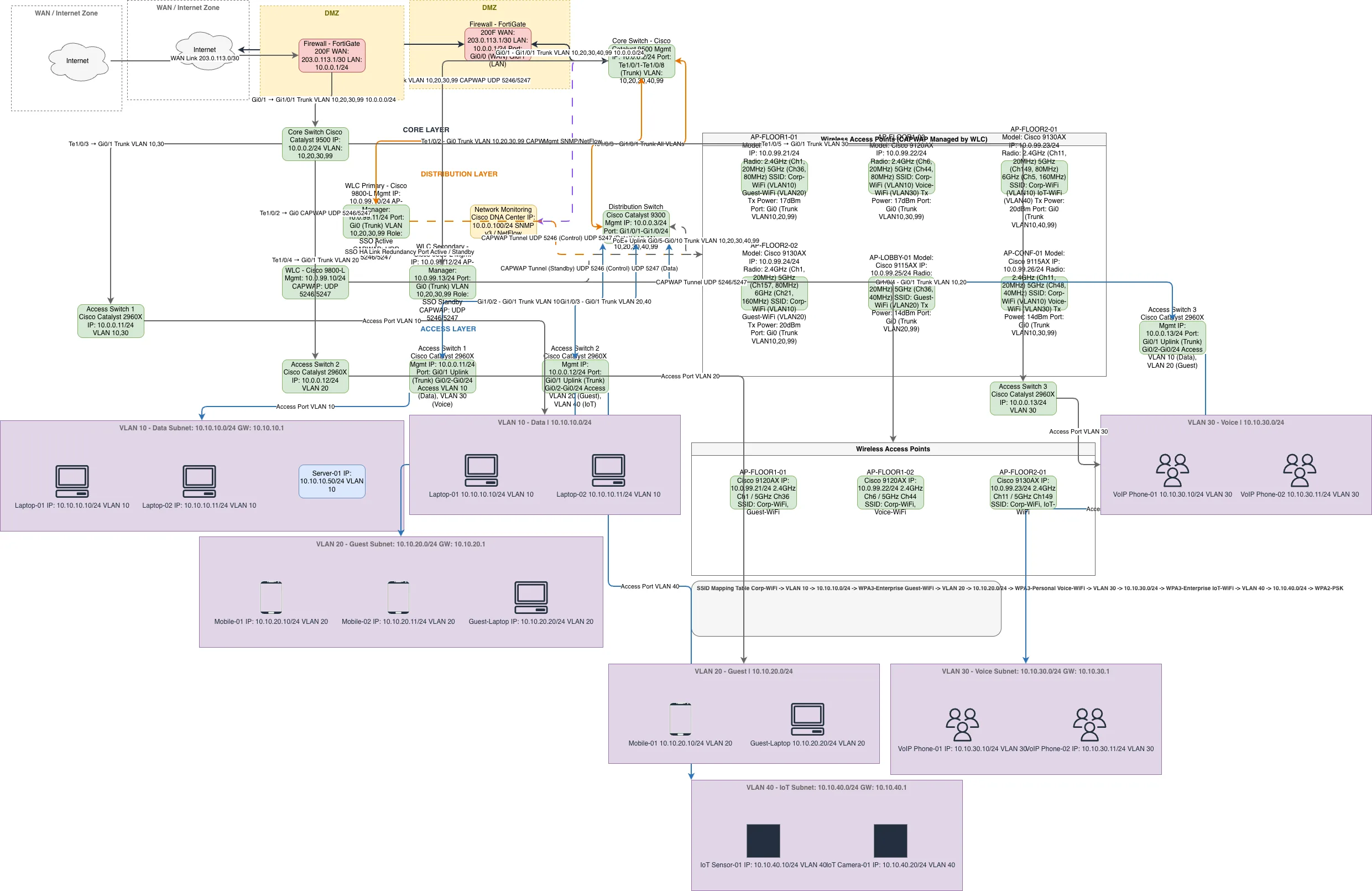
Enterprise wireless network topology integrating Cisco Catalyst switches, FortiGate firewall, and WLC-managed access points across four VLANs for data, guest, voice, and IoT traffic. Traffic flows from Internet through FortiGate (203.0.113.1/30) into Core Switch 9500, then through Distribution Switch 9300 and WLC 9800-L to three Access Switches (2960X) serving laptops, mobile devices, VoIP phones, and IoT sensors. This architecture demonstrates hierarchical network design with VLAN segmentation (VLAN 10 data, VLAN 20 guest, VLAN 30 voice, VLAN 40 IoT) and CAPWAP-managed access points (9120AX, 9130AX, 9115AX) across multiple floors. The design separates management traffic (10.0.0.0/24, 10.0.99.0/24) from user data, enabling QoS policies, security policies, and scalable wireless coverage. Fork this diagram on Diagrams.so to customize IP addressing, add additional access points, or integrate with your authentication backend. Consider adding redundant uplinks and spanning-tree tuning for production deployments.

People also ask

How do I design a scalable enterprise wireless network with Cisco switches and WLC controller?

This diagram shows a hierarchical enterprise wireless architecture using Cisco Catalyst 9500 core, 9300 distribution, and 2960X access switches managed by WLC 9800-L. Traffic is segmented into four VLANs (data, guest, voice, IoT) with CAPWAP-managed access points (9120AX, 9130AX, 9115AX) providing coverage across floors, enabling QoS policies and security isolation.

Ciscowireless networkenterprise architectureVLAN segmentationWLC controllernetwork design
Domain:
Networking
Audience:
Network architects designing enterprise wireless infrastructure with Cisco equipment

Generated by Diagrams.so — AI architecture diagram generator with native Draw.io output. Fork this diagram, remix it, or download as .drawio, PNG, or SVG.

Generate your own network diagram →

About This Architecture

Enterprise wireless network topology integrating Cisco Catalyst switches, FortiGate firewall, and WLC-managed access points across four VLANs for data, guest, voice, and IoT traffic. Traffic flows from Internet through FortiGate (203.0.113.1/30) into Core Switch 9500, then through Distribution Switch 9300 and WLC 9800-L to three Access Switches (2960X) serving laptops, mobile devices, VoIP phones, and IoT sensors. This architecture demonstrates hierarchical network design with VLAN segmentation (VLAN 10 data, VLAN 20 guest, VLAN 30 voice, VLAN 40 IoT) and CAPWAP-managed access points (9120AX, 9130AX, 9115AX) across multiple floors. The design separates management traffic (10.0.0.0/24, 10.0.99.0/24) from user data, enabling QoS policies, security policies, and scalable wireless coverage. Fork this diagram on Diagrams.so to customize IP addressing, add additional access points, or integrate with your authentication backend. Consider adding redundant uplinks and spanning-tree tuning for production deployments.

People also ask

How do I design a scalable enterprise wireless network with Cisco switches and WLC controller?

This diagram shows a hierarchical enterprise wireless architecture using Cisco Catalyst 9500 core, 9300 distribution, and 2960X access switches managed by WLC 9800-L. Traffic is segmented into four VLANs (data, guest, voice, IoT) with CAPWAP-managed access points (9120AX, 9130AX, 9115AX) providing coverage across floors, enabling QoS policies and security isolation.

Enterprise Wireless Network Topology -

AutoadvancedCiscowireless networkenterprise architectureVLAN segmentationWLC controllernetwork design
Domain: NetworkingAudience: Network architects designing enterprise wireless infrastructure with Cisco equipment
0 views0 favoritesPublic

Created by

May 8, 2026

Updated

May 8, 2026 at 12:26 AM

Type

network

Need a custom architecture diagram?

Describe your architecture in plain English and get a production-ready Draw.io diagram in seconds. Works for AWS, Azure, GCP, Kubernetes, and more.

Generate with AI