Enterprise UML Use Case and AWS Architecture
About This Architecture
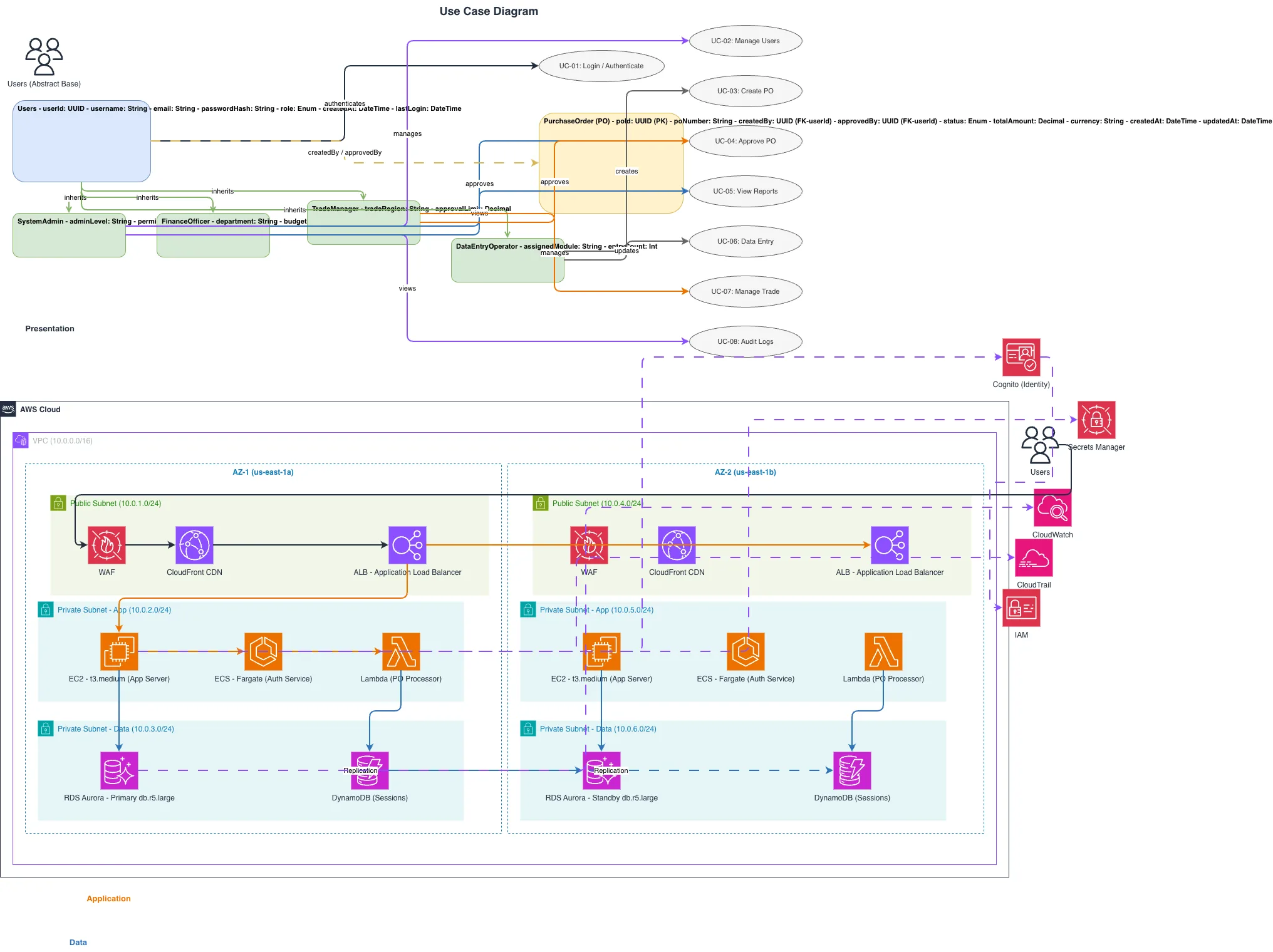
Enterprise UML use case model integrated with a highly available AWS architecture spanning two availability zones in us-east-1. The system models eight core use cases—Login, Manage Users, Create PO, Approve PO, View Reports, Data Entry, Manage Trade, and Audit Logs—across four user roles: SystemAdmin, FinanceOfficer, TradeManager, and DataEntryOperator. AWS infrastructure includes a VPC with public subnets hosting WAF and CloudFront CDN, ALBs routing to private app subnets running EC2 t3.medium instances, ECS Fargate for authentication, and Lambda for PO processing, backed by RDS Aurora (primary/standby) and DynamoDB sessions. Cognito manages identity, Secrets Manager secures credentials, and CloudWatch plus CloudTrail provide observability and compliance audit trails. This architecture demonstrates enterprise-grade resilience, security, and role-based workflow orchestration suitable for financial and procurement systems. Fork and customize this diagram on Diagrams.so to adapt subnets, instance types, or add additional AWS services like SNS for notifications or S3 for document storage.
People also ask
How do I design a highly available AWS architecture for an enterprise procurement system with role-based access control and audit compliance?
This diagram shows a two-AZ AWS architecture using VPC with public and private subnets, ALBs, EC2/ECS/Lambda for compute, RDS Aurora for HA databases, DynamoDB for sessions, Cognito for identity, and CloudTrail for audit logs. The integrated UML model defines eight use cases and four user roles (SystemAdmin, FinanceOfficer, TradeManager, DataEntryOperator) to enforce least-privilege access and wor
- Domain:
- Cloud Aws
- Audience:
- AWS solutions architects designing multi-tier enterprise applications with role-based access control
Generated by Diagrams.so — AI architecture diagram generator with native Draw.io output. Fork this diagram, remix it, or download as .drawio, PNG, or SVG.
