Enterprise Application Architecture - Six Layers
MULTINetworkadvanced
Enterprise Application Architecture - Six Layers — MULTI network diagram

About This Architecture

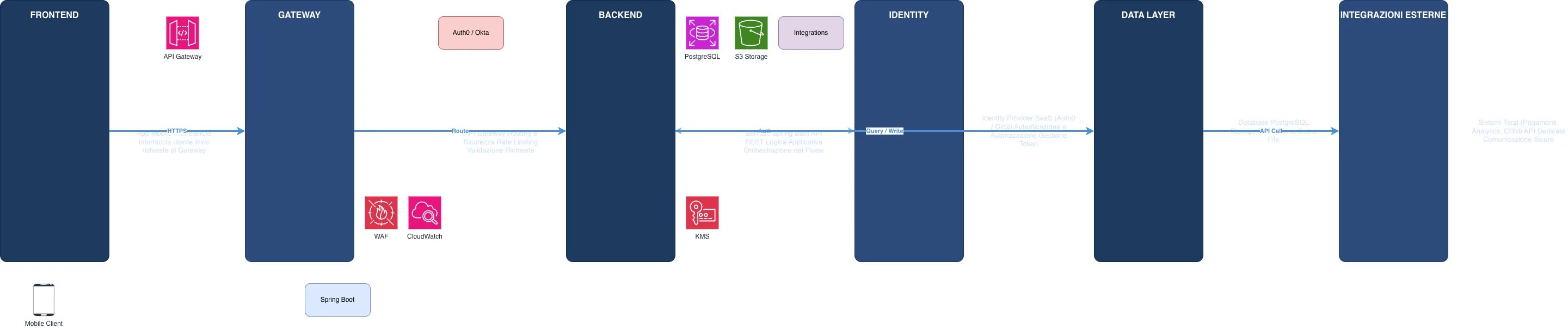
Six-layer enterprise application architecture integrating mobile clients, API Gateway, Spring Boot microservices, Auth0/Okta identity management, PostgreSQL databases, and S3 storage across multi-cloud infrastructure. Traffic flows from mobile frontends through an API Gateway with rate limiting and WAF protection to Spring Boot backend services, which orchestrate authentication via identity providers and data persistence through PostgreSQL and S3. The architecture enforces security at every layer—KMS encryption, request validation, and secure API integrations with third-party systems for payments, analytics, and CRM. This pattern demonstrates enterprise-grade separation of concerns, enabling teams to scale frontend, backend, and data layers independently while maintaining centralized security and observability through CloudWatch. Fork this diagram to customize for your cloud provider stack, adjust authentication flows, or add additional integration endpoints.

People also ask

What does a production-ready six-layer enterprise application architecture look like across multi-cloud platforms?

This diagram shows a proven six-layer pattern: mobile frontends connect via API Gateway (with WAF and rate limiting), route to Spring Boot REST services handling business logic, authenticate through Auth0/Okta, persist data in PostgreSQL and S3, and integrate securely with external systems. Each layer enforces security (KMS encryption, request validation) and observability (CloudWatch monitoring).

enterprise-architecturemulti-cloudmicroservicesapi-gatewayspring-bootidentity-management
Domain:
Cloud Multi
Audience:
Enterprise architects designing scalable multi-cloud application platforms

Generated by Diagrams.so — AI architecture diagram generator with native Draw.io output. Fork this diagram, remix it, or download as .drawio, PNG, or SVG.

Generate your own networkdiagram →

About This Architecture

Six-layer enterprise application architecture integrating mobile clients, API Gateway, Spring Boot microservices, Auth0/Okta identity management, PostgreSQL databases, and S3 storage across multi-cloud infrastructure. Traffic flows from mobile frontends through an API Gateway with rate limiting and WAF protection to Spring Boot backend services, which orchestrate authentication via identity providers and data persistence through PostgreSQL and S3. The architecture enforces security at every layer—KMS encryption, request validation, and secure API integrations with third-party systems for payments, analytics, and CRM. This pattern demonstrates enterprise-grade separation of concerns, enabling teams to scale frontend, backend, and data layers independently while maintaining centralized security and observability through CloudWatch. Fork this diagram to customize for your cloud provider stack, adjust authentication flows, or add additional integration endpoints.

People also ask

What does a production-ready six-layer enterprise application architecture look like across multi-cloud platforms?

This diagram shows a proven six-layer pattern: mobile frontends connect via API Gateway (with WAF and rate limiting), route to Spring Boot REST services handling business logic, authenticate through Auth0/Okta, persist data in PostgreSQL and S3, and integrate securely with external systems. Each layer enforces security (KMS encryption, request validation) and observability (CloudWatch monitoring).

Enterprise Application Architecture - Six Layers

Multiadvancedenterprise-architecturemulti-cloudmicroservicesapi-gatewayspring-bootidentity-management
Domain: Cloud MultiAudience: Enterprise architects designing scalable multi-cloud application platforms
0 views0 favoritesPublic

Created by

May 24, 2026

Updated

May 24, 2026 at 10:43 AM

Type

network

Need a custom architecture diagram?

Describe your architecture in plain English and get a production-ready Draw.io diagram in seconds. Works for AWS, Azure, GCP, Kubernetes, and more.

Generate with AI