E-Commerce Production Backend on AWS
AWSData Pipelineadvanced
E-Commerce Production Backend on AWS — AWS data pipeline diagram

About This Architecture

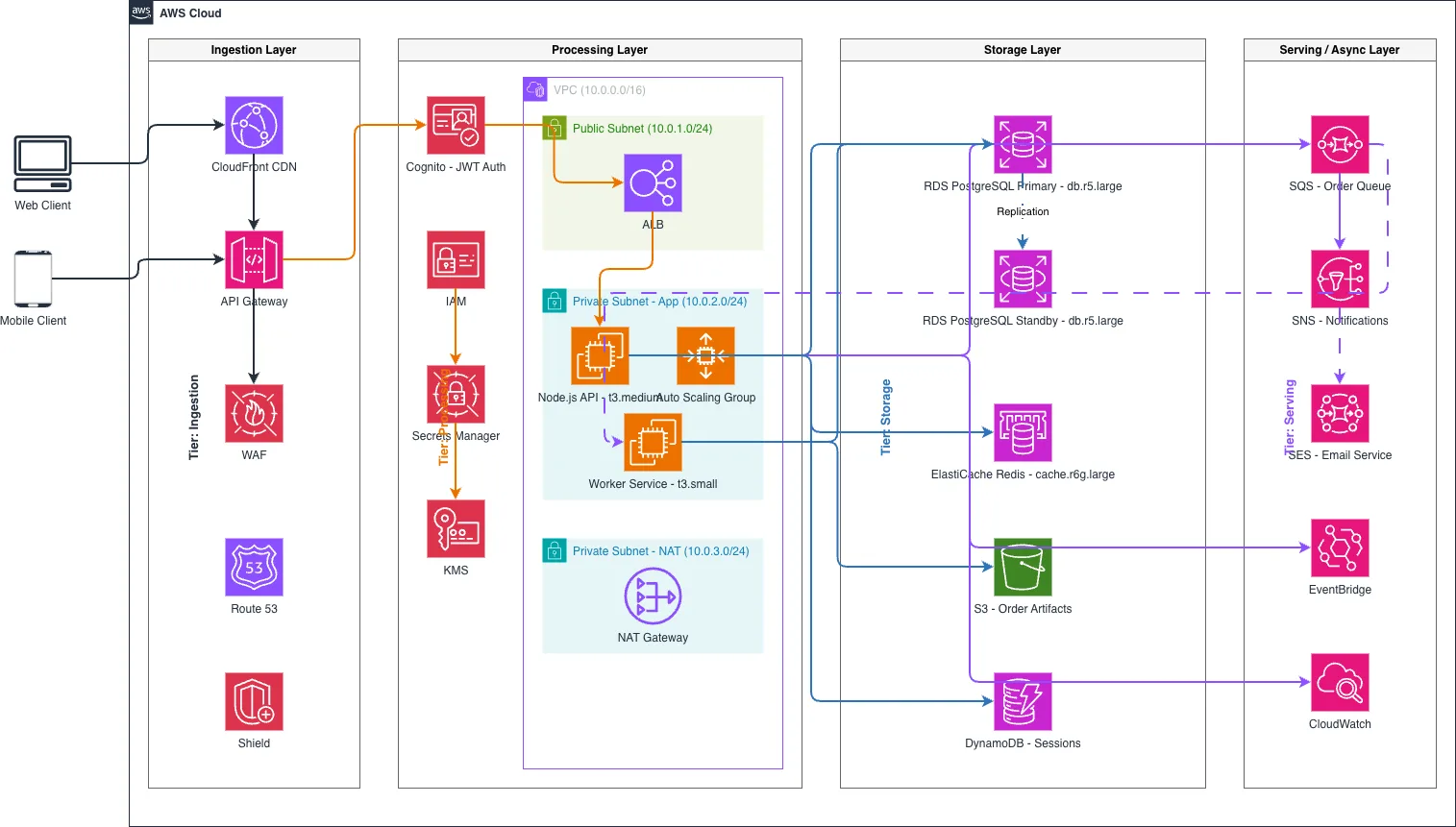
Multi-tier e-commerce backend on AWS integrating CloudFront CDN, API Gateway with WAF, and Route 53 for global ingestion. Node.js APIs in an Auto Scaling Group within a VPC authenticate via Cognito JWT, route through an ALB, and connect to RDS PostgreSQL primary-standby pairs, ElastiCache Redis, and DynamoDB sessions. Asynchronous order processing flows through SQS to Worker Services, triggering SNS notifications via SES email and EventBridge event routing, with S3 storing order artifacts and CloudWatch monitoring the entire pipeline. This architecture demonstrates high-availability, security-first design with IAM, Secrets Manager, and KMS encryption for production e-commerce workloads. Fork this diagram on Diagrams.so to customize instance types, subnet ranges, or add additional services like Lambda or Step Functions. The separation of ingestion, processing, storage, and serving tiers enables independent scaling and failure isolation critical for peak shopping periods.

People also ask

How do I architect a production e-commerce backend on AWS with auto-scaling, database replication, and asynchronous order processing?

This diagram shows a four-tier AWS e-commerce architecture: CloudFront and API Gateway handle ingestion with WAF protection; Node.js APIs in an Auto Scaling Group process requests with Cognito JWT auth and connect to RDS PostgreSQL (primary-standby), ElastiCache Redis, and DynamoDB; SQS queues decouple order processing to Worker Services, which trigger SNS notifications via SES email and EventBrid

AWSe-commercemulti-tier architectureauto-scalingRDS PostgreSQLSQS SNS
Domain:
Cloud Aws
Audience:
AWS solutions architects designing production e-commerce backends

Generated by Diagrams.so — AI architecture diagram generator with native Draw.io output. Fork this diagram, remix it, or download as .drawio, PNG, or SVG.

Generate your own data pipeline diagram →

About This Architecture

Multi-tier e-commerce backend on AWS integrating CloudFront CDN, API Gateway with WAF, and Route 53 for global ingestion. Node.js APIs in an Auto Scaling Group within a VPC authenticate via Cognito JWT, route through an ALB, and connect to RDS PostgreSQL primary-standby pairs, ElastiCache Redis, and DynamoDB sessions. Asynchronous order processing flows through SQS to Worker Services, triggering SNS notifications via SES email and EventBridge event routing, with S3 storing order artifacts and CloudWatch monitoring the entire pipeline. This architecture demonstrates high-availability, security-first design with IAM, Secrets Manager, and KMS encryption for production e-commerce workloads. Fork this diagram on Diagrams.so to customize instance types, subnet ranges, or add additional services like Lambda or Step Functions. The separation of ingestion, processing, storage, and serving tiers enables independent scaling and failure isolation critical for peak shopping periods.

People also ask

How do I architect a production e-commerce backend on AWS with auto-scaling, database replication, and asynchronous order processing?

This diagram shows a four-tier AWS e-commerce architecture: CloudFront and API Gateway handle ingestion with WAF protection; Node.js APIs in an Auto Scaling Group process requests with Cognito JWT auth and connect to RDS PostgreSQL (primary-standby), ElastiCache Redis, and DynamoDB; SQS queues decouple order processing to Worker Services, which trigger SNS notifications via SES email and EventBrid

E-Commerce Production Backend on AWS

AWSadvancede-commercemulti-tier architectureauto-scalingRDS PostgreSQLSQS SNS
Domain: Cloud AwsAudience: AWS solutions architects designing production e-commerce backends
0 views0 favoritesPublic

Created by

May 12, 2026

Updated

May 12, 2026 at 5:35 PM

Type

data pipeline

Need a custom architecture diagram?

Describe your architecture in plain English and get a production-ready Draw.io diagram in seconds. Works for AWS, Azure, GCP, Kubernetes, and more.

Generate with AI