
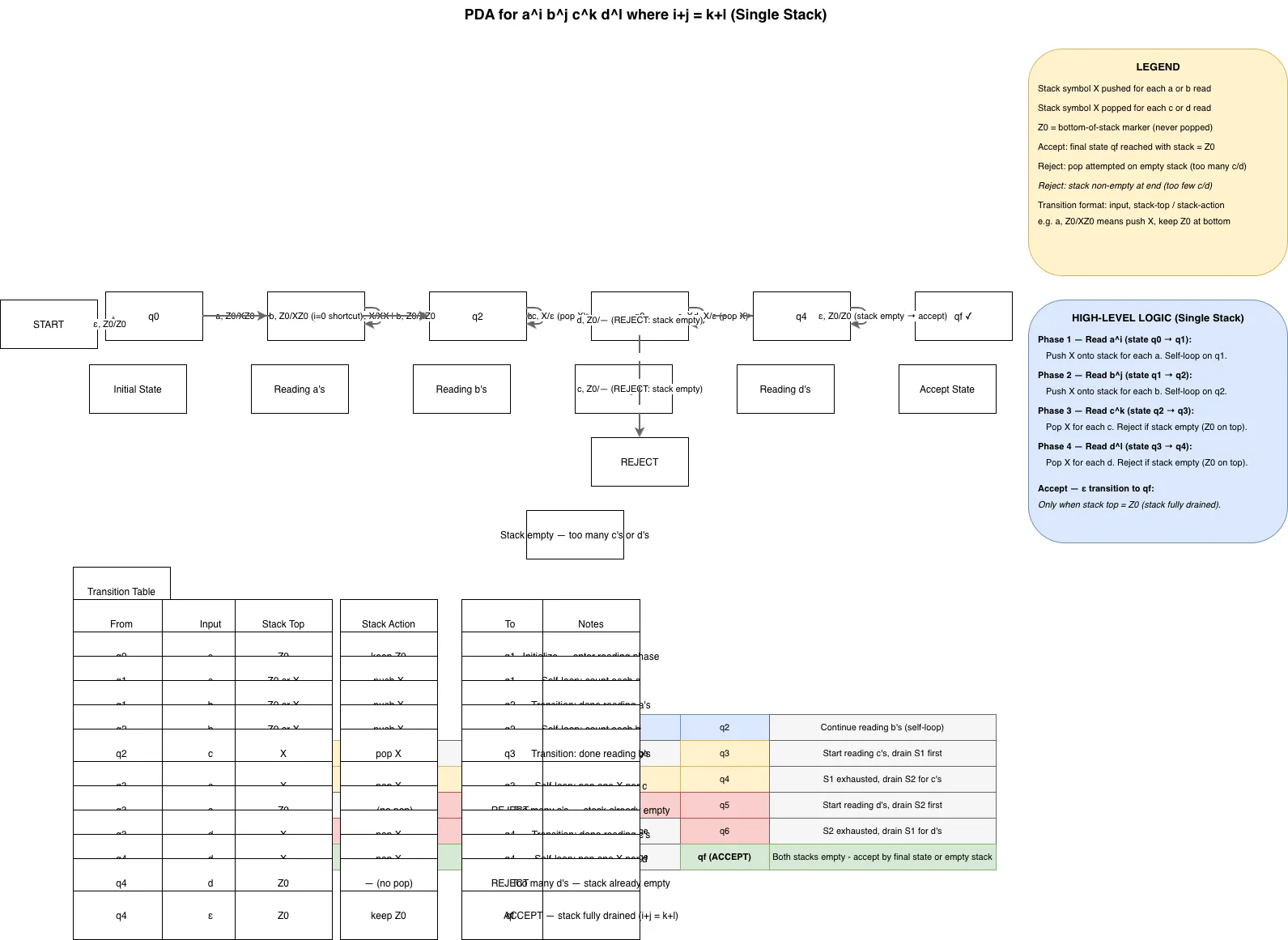
About This Architecture
Dual-stack pushdown automaton (PDA) for recognizing the context-free language a^i b^j c^k d^l where i+j equals k+l, using two independent stacks to track symbol counts. Stack 1 accumulates A symbols during a-reading and b-reading phases, while Stack 2 accumulates B symbols; during c-reading, S1 drains first then S2, and during d-reading, S2 drains first then S1. The automaton transitions through six processing states (q1 through q6) with explicit stack conditions and operations at each transition, ensuring both stacks empty simultaneously to accept. This diagram demonstrates how dual-stack PDAs extend single-stack capabilities to recognize languages requiring multiple independent counters. Fork and customize this diagram on Diagrams.so to explore variations, add detailed transition labels, or adapt it for teaching formal language theory.