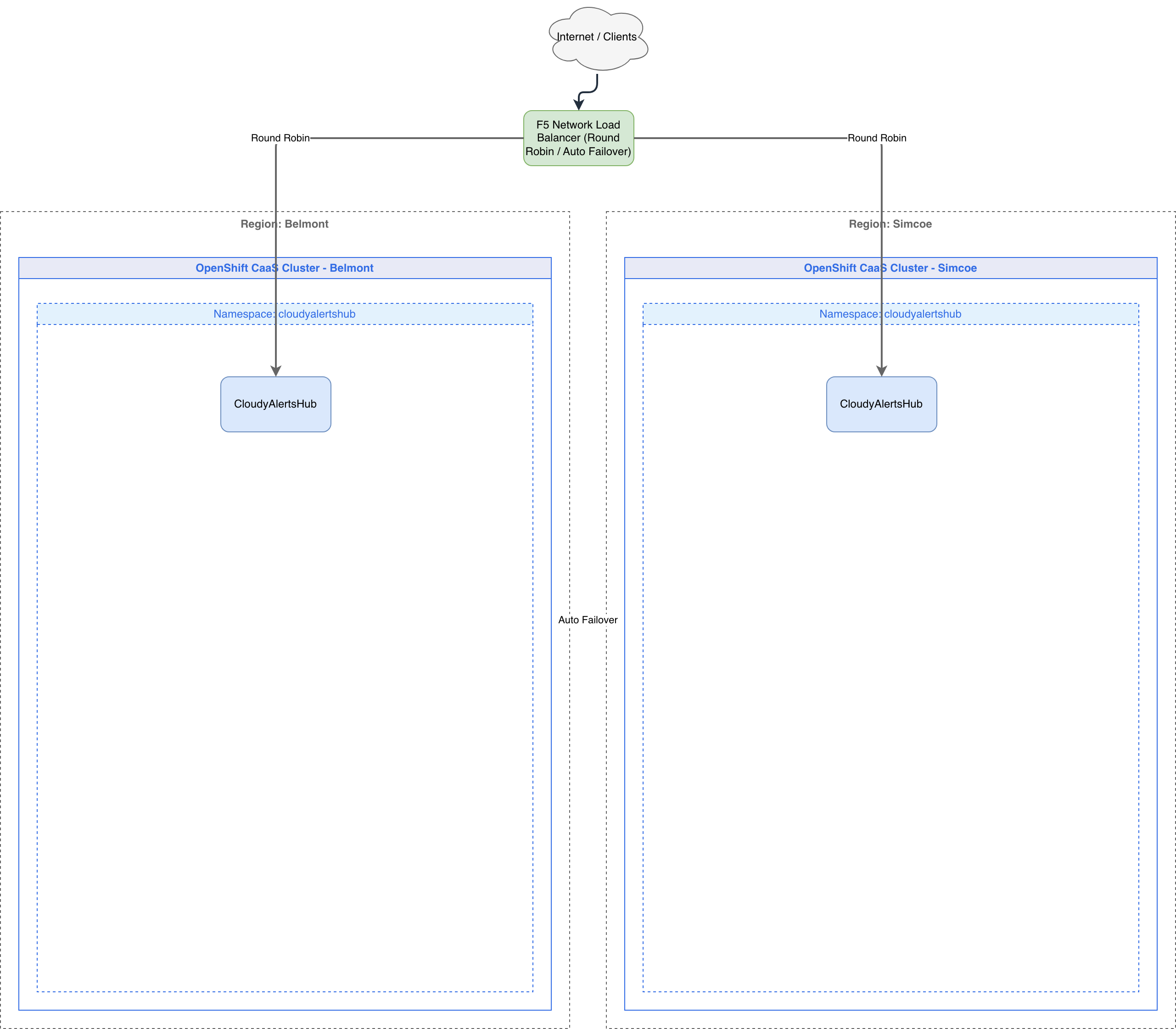
CloudyAlertsHub Multi-Region OpenShift Deployment

general · architecture diagram.

About This Architecture

Multi-region OpenShift deployment with F5 load balancing across Belmont and Simcoe clusters running CloudyAlertsHub microservices. Traffic flows from clients through an F5 Network Load Balancer with round-robin and auto-failover to OpenShift Ingress Controllers in each region, then to REST API Gateway Pods that route requests to Alerts Service, Notification Service, and Routing Service microservices. Each region maintains an in-memory cache layer for low-latency data access across the distributed architecture. This pattern demonstrates high availability and geographic redundancy for mission-critical alert systems, eliminating single points of failure and enabling seamless failover between regions. Fork this diagram on Diagrams.so to customize namespaces, add additional regions, or integrate with your monitoring and observability stack. Consider adding network policies and pod disruption budgets to further harden the deployment for production workloads.

People also ask

How do you design a multi-region OpenShift deployment with automatic failover and load balancing?

This diagram shows a production architecture using an F5 Network Load Balancer to distribute traffic across OpenShift clusters in Belmont and Simcoe regions. Each cluster runs the same microservices (Alerts Service, Notification Service, Routing Service) within the cloudyalertshub namespace, with in-memory cache layers for performance and automatic failover ensuring continuous availability.

CloudyAlertsHub Multi-Region OpenShift Deployment

AutoadvancedOpenShiftKubernetesmulti-regionload-balancingmicroserviceshigh-availability
Domain: KubernetesAudience: Kubernetes platform engineers deploying multi-region OpenShift clusters
0 views0 favoritesPublic

Created by

April 1, 2026

Updated

April 1, 2026 at 1:35 PM

Type

architecture

Need a custom architecture diagram?

Describe your architecture in plain English and get a production-ready Draw.io diagram in seconds. Works for AWS, Azure, GCP, Kubernetes, and more.

Generate with AI