Clasificacion Normativa AASHTO - Suelos Viales
About This Architecture
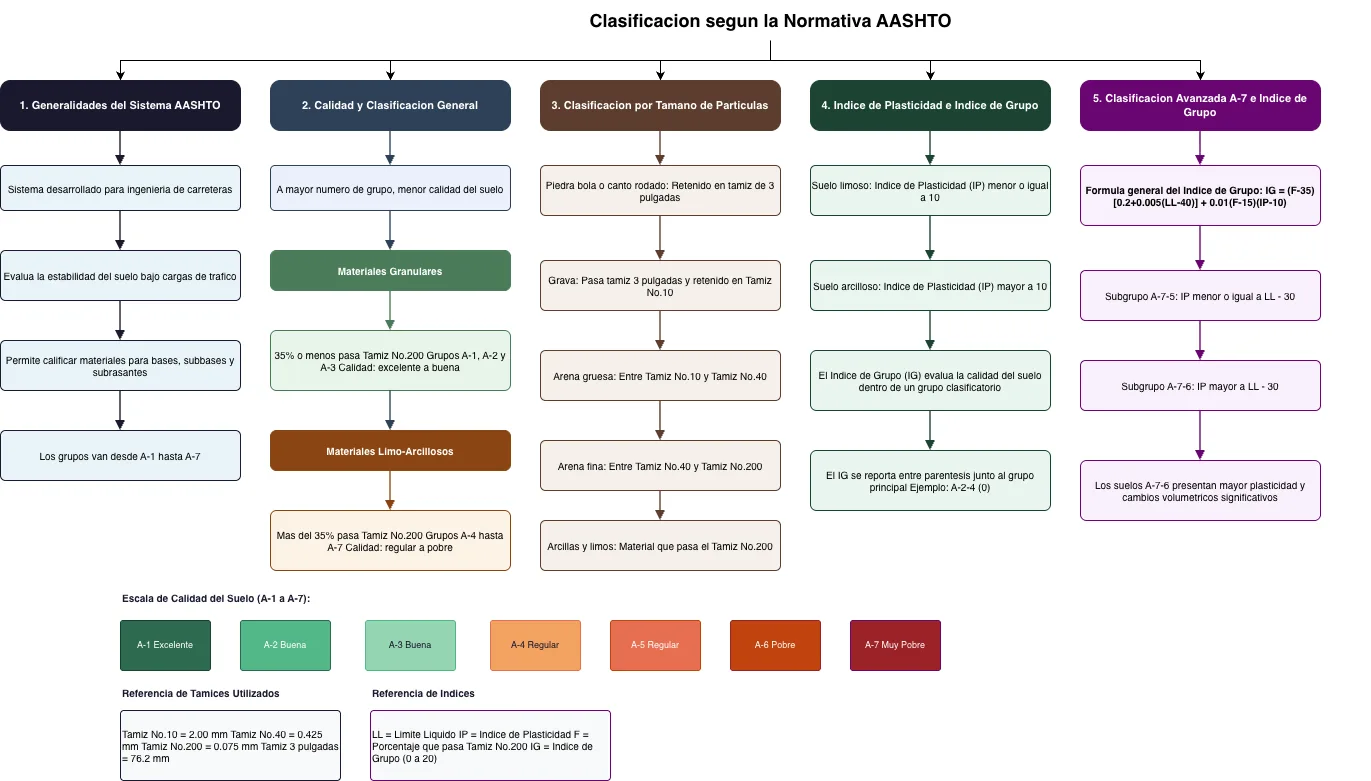
AASHTO soil classification system for road construction organizes soils into groups A-1 through A-7 based on particle size, plasticity index, and sieve analysis. The framework divides materials into granular soils (A-1 to A-3, ≤35% passing No. 200 sieve) and silt-clay soils (A-4 to A-7, >35% passing No. 200 sieve), with quality ratings from excellent to very poor. Plasticity index and group index calculations determine subgroup assignments, particularly for A-7 soils, which exhibit significant volumetric changes. This classification enables engineers to evaluate soil stability under traffic loads and qualify materials for bases, subbases, and subgrades. Fork and customize this diagram on Diagrams.so to integrate AASHTO classifications into your pavement design documentation or training materials.
People also ask
How does the AASHTO soil classification system categorize soils for road construction and pavement design?
The AASHTO system classifies soils into groups A-1 through A-7 based on sieve analysis (particle size), plasticity index, and group index calculations. Granular soils (A-1 to A-3) with ≤35% passing the No. 200 sieve rate excellent to good quality, while silt-clay soils (A-4 to A-7) with >35% passing rate regular to very poor quality, enabling engineers to select appropriate materials for bases, su
- Domain:
- Other
- Audience:
- Civil engineers and pavement designers classifying soils per AASHTO standards
Generated by Diagrams.so — AI architecture diagram generator with native Draw.io output. Fork this diagram, remix it, or download as .drawio, PNG, or SVG.
