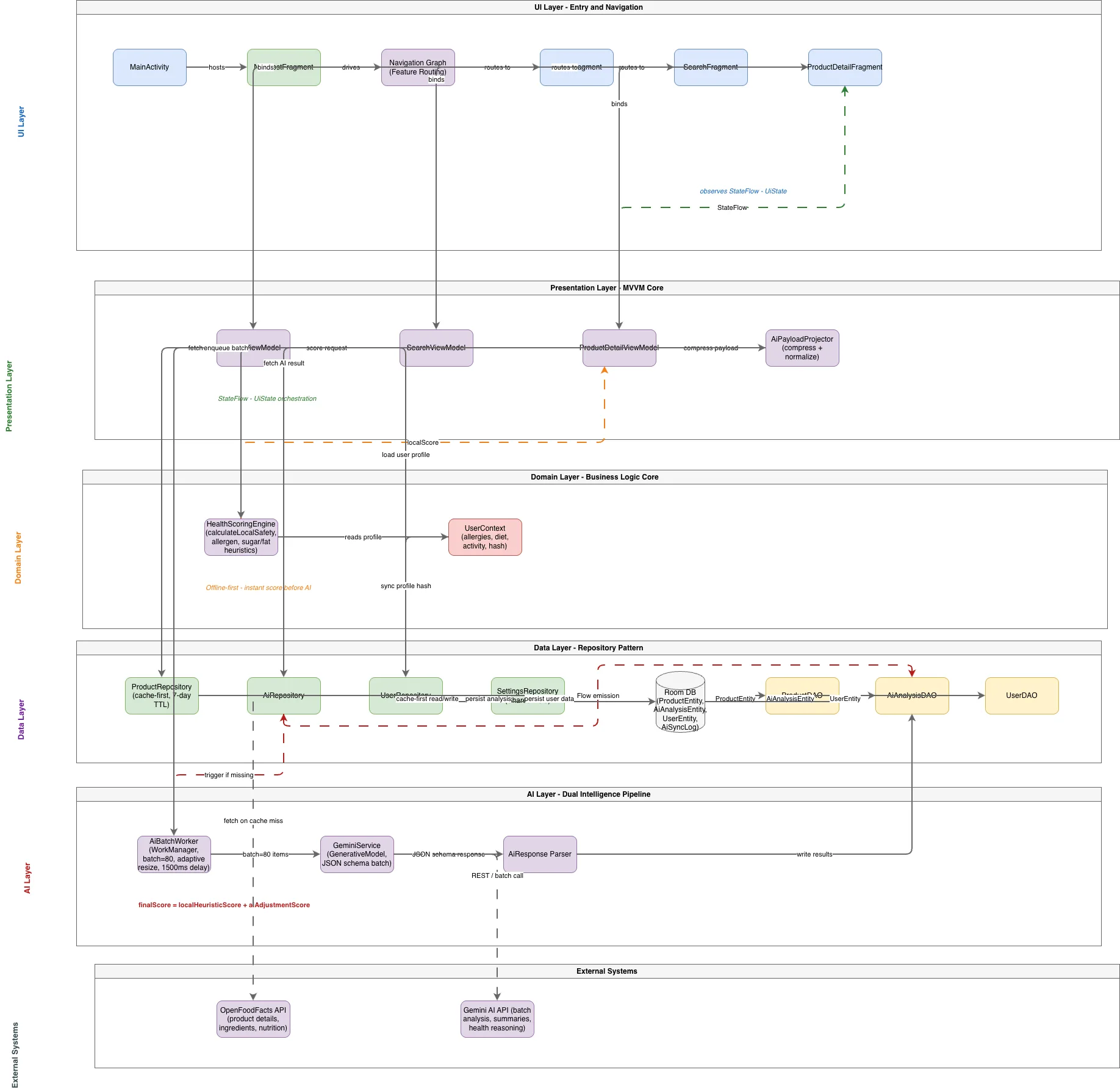
BiteWise Full Runtime Architecture

GENERALNetworkadvanced
BiteWise Full Runtime Architecture — GENERAL network diagram

About This Architecture

BiteWise implements a layered MVVM architecture combining local heuristic scoring with AI-powered health analysis for food products. Data flows from UI fragments through ViewModels to repositories, which cache product details via Room DB and coordinate batch AI analysis through WorkManager and Gemini API. The HealthScoringEngine calculates instant safety scores offline using allergen and nutritional heuristics, while AiBatchWorker asynchronously enriches results with AI reasoning, merging local and remote intelligence into a final composite score. Fork this diagram to customize feature routing, adjust batch sizing, or integrate alternative AI providers like Claude or local TensorFlow models. The architecture prioritizes offline responsiveness and adaptive batch processing, making it ideal for health apps serving users with intermittent connectivity.

People also ask

How do I architect an Android health app that scores food safety offline and enriches results with AI analysis asynchronously?

BiteWise uses a five-layer MVVM architecture: UI fragments observe StateFlow from ViewModels, which orchestrate ProductRepository (Room DB cache), HealthScoringEngine (instant local scoring), and AiRepository (Gemini batch analysis via WorkManager). The HealthScoringEngine calculates scores offline using allergen and nutritional heuristics, while AiBatchWorker asynchronously processes batches of 8

AndroidMVVMoffline-firstRoom DatabaseWorkManagerGemini AI
Domain:
Software Architecture
Audience:
Android developers building health & nutrition apps with offline-first architecture

Generated by Diagrams.so — AI architecture diagram generator with native Draw.io output. Fork this diagram, remix it, or download as .drawio, PNG, or SVG.

Generate your own network diagram →

About This Architecture

BiteWise implements a layered MVVM architecture combining local heuristic scoring with AI-powered health analysis for food products. Data flows from UI fragments through ViewModels to repositories, which cache product details via Room DB and coordinate batch AI analysis through WorkManager and Gemini API. The HealthScoringEngine calculates instant safety scores offline using allergen and nutritional heuristics, while AiBatchWorker asynchronously enriches results with AI reasoning, merging local and remote intelligence into a final composite score. Fork this diagram to customize feature routing, adjust batch sizing, or integrate alternative AI providers like Claude or local TensorFlow models. The architecture prioritizes offline responsiveness and adaptive batch processing, making it ideal for health apps serving users with intermittent connectivity.

People also ask

How do I architect an Android health app that scores food safety offline and enriches results with AI analysis asynchronously?

BiteWise uses a five-layer MVVM architecture: UI fragments observe StateFlow from ViewModels, which orchestrate ProductRepository (Room DB cache), HealthScoringEngine (instant local scoring), and AiRepository (Gemini batch analysis via WorkManager). The HealthScoringEngine calculates scores offline using allergen and nutritional heuristics, while AiBatchWorker asynchronously processes batches of 8

BiteWise Full Runtime Architecture

AutoadvancedAndroidMVVMoffline-firstRoom DatabaseWorkManagerGemini AI
Domain: Software ArchitectureAudience: Android developers building health & nutrition apps with offline-first architecture
0 views0 favoritesPublic

Created by

April 21, 2026

Updated

April 21, 2026 at 2:16 AM

Type

network

Need a custom architecture diagram?

Describe your architecture in plain English and get a production-ready Draw.io diagram in seconds. Works for AWS, Azure, GCP, Kubernetes, and more.

Generate with AI