AWS Video Upload Microservices Architecture
AWSMicroservicesadvanced
AWS Video Upload Microservices Architecture — AWS microservices diagram

About This Architecture

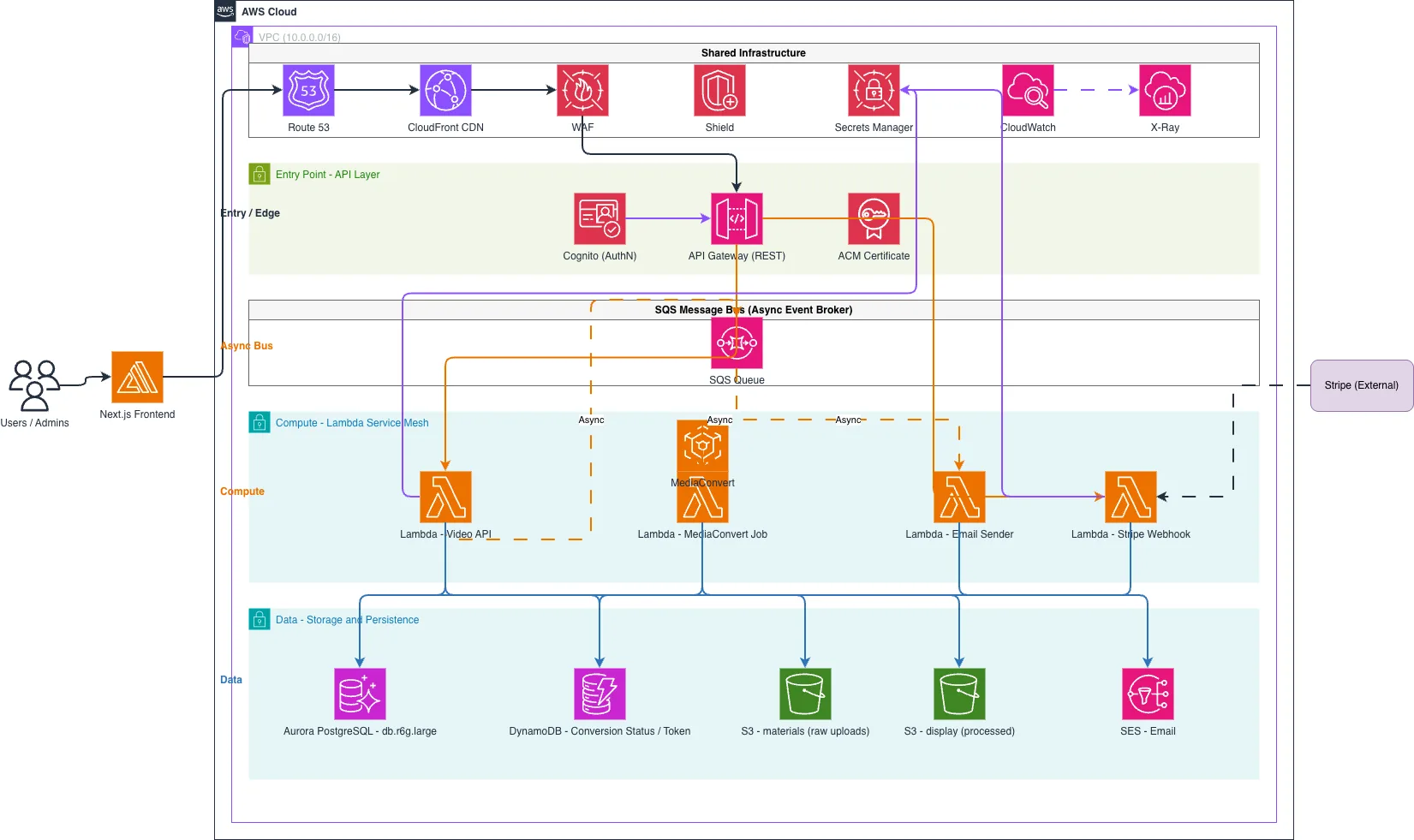
Event-driven microservices architecture for video upload and processing using AWS Lambda, SQS, and MediaConvert. Users authenticate via Cognito, upload videos through API Gateway protected by CloudFront and WAF, then async Lambda functions orchestrate transcoding, storage, and notifications via SQS message bus. Aurora PostgreSQL and DynamoDB persist metadata and conversion status while S3 buckets store raw and processed video assets. This pattern decouples upload, processing, and notification workflows, enabling independent scaling and fault isolation across compute, storage, and messaging layers. Fork this diagram on Diagrams.so to customize Lambda concurrency, SQS batch sizes, or add additional processors like thumbnail generation or subtitle extraction. The architecture demonstrates best practices for cost-efficient, asynchronous video pipelines by leveraging managed services and event-driven decoupling.

People also ask

How do I build a scalable, serverless video upload and processing system on AWS using asynchronous microservices?

This diagram shows a decoupled event-driven architecture where API Gateway receives video uploads, Lambda functions push jobs to SQS, and separate Lambda workers process transcoding via MediaConvert while storing metadata in Aurora and DynamoDB. CloudFront and WAF protect the frontend, Cognito handles authentication, and SES sends notifications—enabling independent scaling and fault isolation acro

AWSmicroservicesserverlessLambdaevent-drivenvideo-processing
Domain:
Cloud Aws
Audience:
AWS solutions architects designing serverless video processing platforms

Generated by Diagrams.so — AI architecture diagram generator with native Draw.io output. Fork this diagram, remix it, or download as .drawio, PNG, or SVG.

Generate your own microservicesdiagram →

About This Architecture

Event-driven microservices architecture for video upload and processing using AWS Lambda, SQS, and MediaConvert. Users authenticate via Cognito, upload videos through API Gateway protected by CloudFront and WAF, then async Lambda functions orchestrate transcoding, storage, and notifications via SQS message bus. Aurora PostgreSQL and DynamoDB persist metadata and conversion status while S3 buckets store raw and processed video assets. This pattern decouples upload, processing, and notification workflows, enabling independent scaling and fault isolation across compute, storage, and messaging layers. Fork this diagram on Diagrams.so to customize Lambda concurrency, SQS batch sizes, or add additional processors like thumbnail generation or subtitle extraction. The architecture demonstrates best practices for cost-efficient, asynchronous video pipelines by leveraging managed services and event-driven decoupling.

People also ask

How do I build a scalable, serverless video upload and processing system on AWS using asynchronous microservices?

This diagram shows a decoupled event-driven architecture where API Gateway receives video uploads, Lambda functions push jobs to SQS, and separate Lambda workers process transcoding via MediaConvert while storing metadata in Aurora and DynamoDB. CloudFront and WAF protect the frontend, Cognito handles authentication, and SES sends notifications—enabling independent scaling and fault isolation acro

AWS Video Upload Microservices Architecture

AWSadvancedserverlessLambdaevent-drivenvideo-processing
Domain: Cloud AwsAudience: AWS solutions architects designing serverless video processing platforms
0 views0 favoritesPublic

Created by

May 25, 2026

Updated

May 25, 2026 at 1:29 PM

Type

microservices

Need a custom architecture diagram?

Describe your architecture in plain English and get a production-ready Draw.io diagram in seconds. Works for AWS, Azure, GCP, Kubernetes, and more.

Generate with AI