AWS Unified Write and Read Flow Architecture
About This Architecture
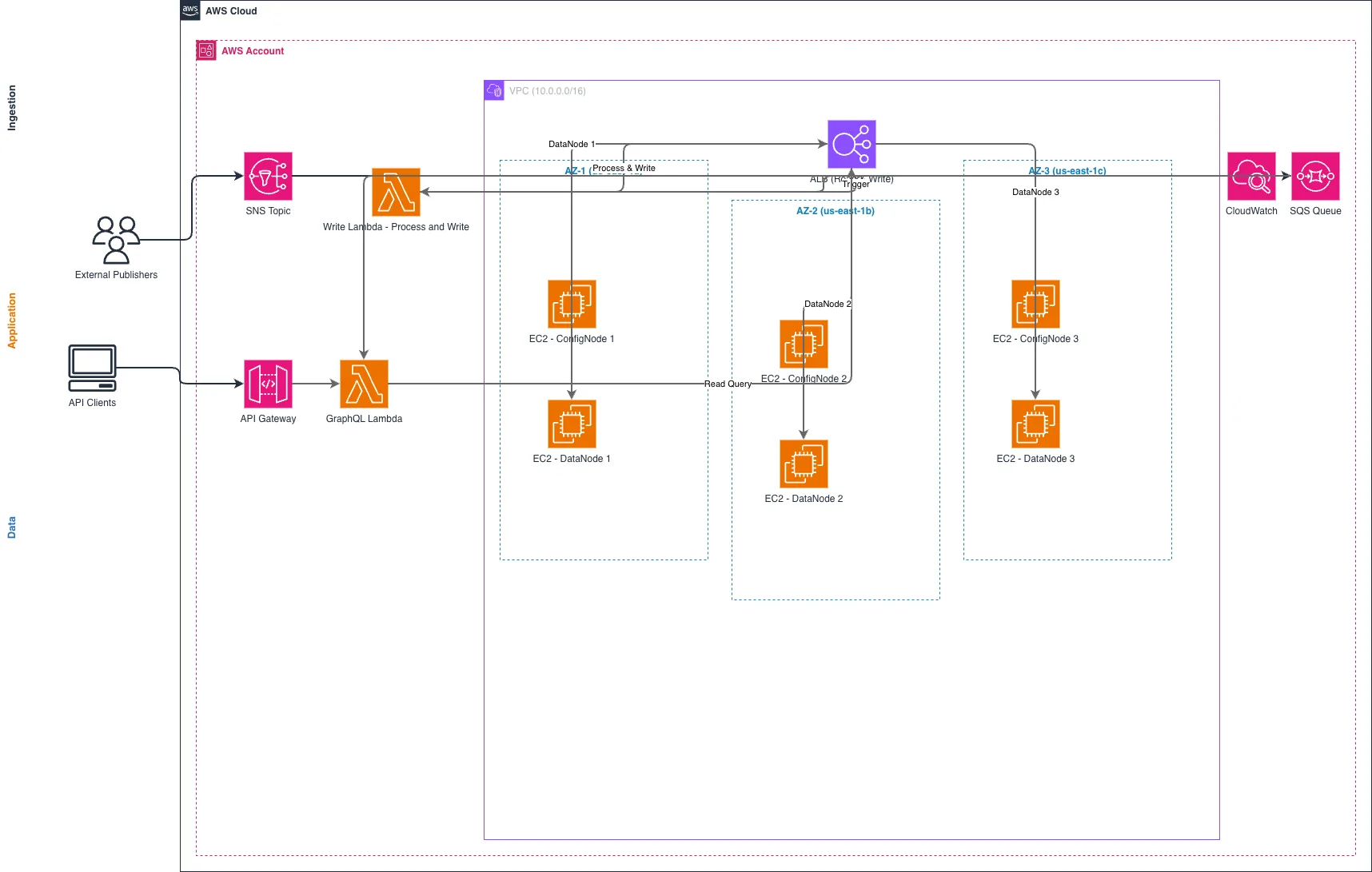
AWS Unified Write and Read Flow Architecture separates write and read workloads across dedicated Lambda functions, load balancers, and database tiers within a multi-AZ VPC. External Publishers trigger SNS Topics that feed SQS Queues to Write Lambda for asynchronous processing into RDS Primary, while API Clients query through API Gateway and GraphQL Lambda against read replicas and standby instances. This pattern isolates write contention from read latency, enabling independent scaling of each tier and reducing blast radius during traffic spikes. Fork this diagram on Diagrams.so to customize subnets, instance types, or add caching layers like ElastiCache. The architecture demonstrates AWS best practices for CQRS-inspired separation, multi-AZ resilience, and CloudWatch observability across both write and read paths.
People also ask
How do I separate write and read workloads in AWS to improve database performance and scalability?
This diagram shows a unified write-read architecture where External Publishers trigger SNS Topics feeding SQS Queues to Write Lambda for RDS Primary writes, while API Clients query GraphQL Lambda against read replicas and standby instances across multi-AZ subnets. This separation enables independent scaling, reduces write contention, and improves read latency through dedicated database tiers.
- Domain:
- Cloud Aws
- Audience:
- AWS solutions architects designing scalable write-heavy and read-optimized database architectures
Generated by Diagrams.so — AI architecture diagram generator with native Draw.io output. Fork this diagram, remix it, or download as .drawio, PNG, or SVG.
